
 Paul Amara, Consultant, Centre des stratégies pour la sécurité du Sahel Sahara, Centre4s.org
Cigarette smuggling generates billions of dollars annually worldwide, including in the Sahel. This complex trade originates in the Balkans and the United Arab Emirates, passes through North Africa, and ends in Libya, from where it streams into the Sahel. Libya is therefore considered the hub of cigarette smuggling in the Sahel. Widespread corruption, porous borders, and a lack of cooperation between countries fuel the growth of cigarette smuggling. The identifiable actors involved are also numerous. These include major countries, major brands, criminals, government officials, and terrorists who operate throughout the Sahel. The scale of the problem makes combating it a monumental task.
In 2017, more than 10 billion cigarettes, manufactured in the Jebel Ali free trade zone in the United Arab Emirates, were reportedly exported illegally to North Africa via Greece and the Balkans. Of this batch, through the same channel, nearly 4 billion was allegedly redirected to Tunisia, 2 billion to Libya, and another portion reintroduced into Western Europe. This trafficking is generally carried out using cargo ships. The traffickers transfer the goods between vessels in the Mediterranean. In collusion with militias, the smugglers travel to a predetermined agreed upon location with their ships and exchange fuel and other goods for illicit cigarettes. They also, sometimes, use airplanes.
Some smuggling practices.
This smuggling uses practices including the following:
- Diversion of destinations or goods, as deceitful transit: that refers to cigarettes exported to Sahel countries, or others, and smuggled across the Sahara to return, illegally, to Europe via the Mediterranean itineraries.
- The final delivery location is not specified in the bill of lading, but another country is indicated as the final destination on the rerouting authorization.
- At the complicit behest of customs officials, a shipment of cigarettes is seized and placed in storage. A few days later, these storage facilities are attacked by jihadists who recover the shipment.
- A country’s market is deliberately oversupplied by tobacco importers. It will be clear that a significant portion is actually destined for smuggling to supply terrorist groups.
- Unbranded cigarettes are, for example, loaded onto trucks bound for Mali, Niger, Algeria, and…Europe! They are imported from Greece and the United Arab Emirates, transiting through the desert and then making their way to Europe via the Mediterranean! The American Legend brand, produced by Karelia Tobacco Company Inc. in Greece, is identified as an illicit white-label product in Europe.
- “Negotiations with Customs”: The nature of truck loads, whether the brand of cigarettes or their quantity, is not controlled. As a result, the tax paid by the freight forwarder is systematically “negotiated,” and therefore reduced.
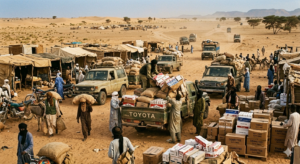
- Porous borders: Cigarettes are transported by pickup trucks, which are smaller, faster, and more discreet, and by motorcycles “under the escort of armed groups.” They can also be transported in car trunks.
- Smugglers sometimes sell cigarettes that are not only illicit but also of poor quality, low in tar and nicotine, produced locally under clandestine conditions. Customs officials, in exchange for bribes, allow them to acquire much larger quantities. In principle, the law imposes a 20% tax in this case.
- Cigarette Evasion through Airport Duty-Free Shops. The quantity of cigarettes that air travelers can purchase in airport duty-free shops is limited to personal consumption. Airport checks, such as those reportedly carried out in Kano, Nigeria, reveal that the cigarettes in circulation are contraband and originate primarily from the Middle East and the United States.
- Circumventing Checkpoints: Some truck drivers avoid major cities and official roads, instead using informal routes to reach their destinations undetected. Even when customs and gendarmerie officers are on the move, smugglers, being informed in advance, take precautions and develop evasion strategies.
- “Negotiations with the army and the administration”: In some countries, faced with these dangers, the army escorts cigarette convoys and “takes its share.” At the same time, the prefectures impose a “tax on cigarettes”… This institutionalizes and secures the privileges enjoyed by smugglers.
These last two techniques led a spokesperson for the National Movement of Azawad (MNLA), which once controlled northern Mali, to claim that smuggling through Niger and further north, at the border, was secured by soldiers and members of the national intelligence services. He also described a well-established drug and illicit cigarette route from Burkina Faso, Mali, and Niger, via Libya, to Egypt. An official from Transparency International’s, Niger branch, explains that cigarette smuggling is the primary cause of instability in northern Niger. That has fostered mafia-like movements that have weakened the army and customs services, ultimately leading to the occupation of the Sahara and the proliferation of weapons. Recent scandals involving cigarette customs fraud have rocked Niger from 2024 to the present day.
The Major players.
The Balkans plays a significant role in cigarette smuggling to North Africa. Their recent, turbulent history allows their high-ranking officials to become involved in organized crime. The various players form a nebulous, octopus-like network. Numerous unknown cigarette brands flood the market. Among the world’s leading multinational cigarette companies are British American Tobacco (BAT) and Camel (R.J. Reynolds), both American, and Philip Morris International (PMI), a Swiss company. The first two claim to be fighting the phenomenon. In 2004, PMI paid $1.25 billion to the European Union to finance the fight against smuggling. It also compensated for tax losses, calculated on the basis of customs seizures of contraband cigarettes. But it stopped short of making a sacrifice. To make up for this, PMI secured the cessation of criminal investigations opened against it in Europe. Not to be outdone, BAT did the same, making $200 million available to the cause in 2010. Both agreements expired in 2016, without being renewed, as they had failed to reduce smuggling. On the contrary, other illegal products flourished: low-priced cigarettes, manufactured legally in Eastern Europe and the Middle East, then sold illegally elsewhere. Experts from the European Union are convinced that smugglers and brands work hand in hand. Specialists also assert that smuggling is essential to the tobacco industry, which thrives on large investments. Indeed, it allows companies to circumvent bans, taxes, and declining revenues in various places. Through smuggling, brands can successfully penetrate closed markets, such as China. Adding to the complexity of this smuggling operation, China Tobacco International Europe Company (CTIEC), a subsidiary of China National Tobacco Corporation (CNTC), built a factory in Romania. Officially, CTIEC was intended to sell Chinese tobacco worldwide. In reality, it allegedly uses Libya as a gateway to African and European markets. In 2021, one of its senior executives and several smugglers were apprehended while planning the illegal shipment of a 17-ton container of illicit cigarettes, destined for Libya, via Italy. South Africa and Iran are also mentioned as transit hubs. Finally, it should be noted that the United Arab Emirates does not cooperate in transnational investigations. Abu Dhabi seems to have adopted the same rules for tobacco as for gold: regardless of its origin or who sells it, it is always welcome.
The profits to those involved in cigarette smuggling, criminal organizations, and terrorist groups are estimated at $40 billion per year worldwide.
Combating cigarette smuggling requires the adoption and implementation of a consensual national policy with tracking tools and, above all, the integrity of all those in charge of control operations throughout the entire chain. A great deal of money is at stake, and therefore risks, given that the main beneficiaries are also terrorists. Cooperation between governments is strategic for the stability of the Sahel. This vast undertaking has been underway for a long time.
In fine, this illicit cigarette trafficking also contributes to the financing of terrorism, and therefore to insecurity of the Sahel, insecurity which, in turn, fuels the trafficking. Hence, a dangerous vicious cycle.
[1] Comment freiner le commerce illégal de tabac en Afrique du Nord ? | ENACT Africa, 14 décembre 2023
[1] Enquête réalisée par Aisha Kehoe Down (OCCRP), Gaston Bonheur Sawadogo (CENOZO), Tom Stocks (OCCRP), Ramdane Guidiguoro (CENOZO), Kétéri Mangal (CENOZO), article publié pour la première fois en mars 2021)
[1] Le Courrier rédigé le 1 septembre 2025, publié dans économie Niger – Fraude et transaction douanière : Une affaire de transaction secoue la Douane nationale ; voir aussi Le Courrier rédigé le 8 juillet 2023. publié dans économie fraude de cigarettes : l’affaire embarrasse la douane nationale
[1] Ibid.
[1] https://newcentre4s.org/ Sahel: l’or au cœur des relations avec les Émirats arabes unis
[1] Ibid