
 Paul AMARA, Consultant, Centre for Security Strategies in the Sahel-Sahara (Centre4s.org)
Since the rise of jihadists in Mali, 2012, numerous mediation efforts have been undertaken by various individuals and organizations—both legal entities and private persons—aimed at reducing the levels of violence in the Sahel. Given the figures of the number of victims and the emergence of new fronts across the region, the overall outcome remains mixed. The toll continues to rise: more deaths, more internally displaced persons and refugees as well as the destruction of vital infrastructures, while peace is recurrently deferred to some future date. Meanwhile, various forms of illicit trafficking—in weapons, drugs (such as cocaine), cigarettes, gold and precious metals, hydrocarbons and human beings—continue to flourish, often generating further revenues through ransoms. As a consequence, Sahelian societies—despite existing within a modern context—are increasingly sliding toward religious radicalism, ethnic tension, and a process of « re-tribalization. »
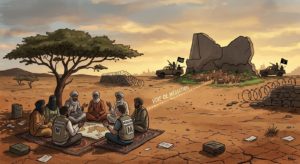
Mediation or attempt to prevent or resolve conflicts between individuals or groups remains a significant tool, particularly in the context of inter-tribal disputes. The Sahel, a region plagued by terrorists’ violence, mediation is carried out by a range of institutional actors, including states, local communities and both national and international associations as well as NGOs. The resulting arrangements often involve community-based entities and can take various forms: implicit ceasefires, non-aggression pacts between communities, or agreements between jihadist groups and the populations they victimize. Such processes may also lead to the establishment of mechanisms for managing resources, including grazing lands, water sources, and transportation routes. These initiatives operate at the intersection of local governance structures—such as traditional chieftaincies, village councils, and other customary or religious authorities. State’s decentralized structures are involved—including administrative entities, defense and security forces and the jurisdictional system—as are jihadist groups, militias, and self-defense organizations.
Most conflicts and acts of violence occur at the community level. They intensify when there are no credible or equitable means to resolve them; fundamentally, they can be traced back to a governance deficit.
Between 2019 and 2025, jihadist groups doubled the number of their attacks in the Sahel. The frequency of these attacks has surged: from 1,900 in 2019 to over 5,500 in 2024, with 3,800 recorded by October 10, 2025—a total of 28,715 attacks over nearly six years. Various factions affiliated to Al-Qaeda—most notably the Group for the Support of Islam and Muslims (JNIM)—as well as those linked to the Islamic State (IS), are now carrying out strikes across nearly all of Mali and Burkina Faso, western Niger and Nigeria, and as far west as the eastern border of Senegal.
The conflict imposed by these jihadist groups now spans more than one million square kilometers. In addition to this vast area, there is a second epicenter of violence in eastern Nigeria, near Lake Chad, where Boko Haram and the Islamic State in West Africa Province (ISWAP) operate. Recent UN reports estimate the number of jihadists affiliated to Al-Qaeda and the Islamic State (IS) to be between 7,000 and 9,000, while the ranks of ISWAP are believed to range from 8,000 to 12,000. Armed largely with weaponry seized during attacks on national armed forces, groups linked to the Islamic State (including Boko Haram) and Al-Qaeda are each responsible for roughly half of the approximately 76,900 casualties recorded since 2019. The majority of those killed perished in clashes with regular military forces, while nearly 16,000 died in attacks targeting civilians. Meanwhile, the JNIM is also advancing westward: the Kayes region, Mali, has experienced more attacks this year than in the previous five years combined. Bordering Senegal, Mauritania and Guinea, this region is a vital conduit for the transport of food and fuel into Mali. In August, the JNIM intensified its deadly raids on this area—a region of particular strategic value, as it accounts for « approximately 80% of Mali’s gold production, » according to the U.S.-based Soufan Center.
Since September, JNIM has specifically targeted fuel tankers arriving from the west to resupply Bamako; after a month-long blockade, fuel shortages are spreading. While more than 20,000 people have been killed in Nigeria, Mali and Burkina Faso, together, account for 56% of the victims of attacks in the Sahel. In Nigeria, protesters marched in Lagos on June 20, 2026, to demonstrate against rising insecurity and a wave of kidnappings affecting several regions of the country. Organized to coincide with Democracy Day, the event brought together people calling on the authorities to do more to combat armed groups, banditry, and mass abductions—particularly in rural communities and schools. Nigerian security forces are struggling with terrorist violence in the Northeast, armed banditry in the Northwest, and kidnappings across various parts of the nation. Furthermore, « a Christian dies every 86 minutes in Nigeria »—a figure provided by the American organization *Equipping the Persecuted* in a report published on September 18, 2026. The organization states that between January 1 and September 8, it recorded 4,216 Christians killed, averaging nearly 17 deaths per day. This toll, based on information gathered on the ground, underscores the scale of the violence afflicting populations already worn down by years of insecurity.
The Sahel region is the « epicenter of global terrorism » and now accounts—for the first time—for « more than half of all terrorism-related deaths, » according to the Global Terrorism Index (GTI). The GTI reports that in 2024, « 51% of all terrorism-related deaths » occurred in the Sahel—3,885 out of a global total of 7,555.
The distress of the Sudanese people is epitomized by the situation in El Fasher, the capital of North Darfur. Following the city’s capture by the Rapid Support Forces (RSF) on October 26, 2025, a series of mass atrocities were committed there. The UN, Yale University, and Amnesty International have estimated the death toll to be between 6,000 and 250,000. The siege of the city lasted 18 months. Systematic killings primarily targeted the Fur, Zaghawa, Masalit, Berti, and other non-Arab communities. Acts perpetrated there included massacres, ethnic cleansing, widespread sexual violence, torture, kidnappings for ransom, and enforced disappearances. Reports also highlight the destruction of medical infrastructure and executions carried out in the immediate vicinity of hospitals. The RSF imposed living conditions deliberately designed to be lethal, intended to starve and exhaust the population. Under international law, this carnage bears the hallmarks of genocide.
In Yemen, UN High Commissioner for Human Rights Volker Türk has expressed concern over the rising number of civilian casualties resulting from the intensifying conflict between the armed group Ansar Allah, the Yemeni government, and their respective affiliated forces. This has inflicted further suffering and fear upon a population already worn down by decades of civil war. A wave of new attacks was launched by the Ansar Allah group at the beginning of August; ground combat, artillery fire, and air strikes—including those involving drones and missiles—have killed or wounded at least 125 civilians. This resumption of hostilities has triggered mass displacement of civilians, some of whom have fled the country, thereby limiting their access to essential services and further damaging already fragile civilian infrastructure. The Office of the United Nations High Commissioner for Human Rights (OHCHR) has recorded 32 civilian deaths—including 15 children and 3 women—since the beginning of August. The renewed violence has led to the displacement of approximately 125,000 people. On August 7, and again on September 7 and 9, forces from the Ansar Allah group carried out three attacks on sites hosting internally displaced persons in the province of Marib.
In Somalia, civilians are being hit particularly hard by the armed conflict between the government—supported by its international allies—and the Al-Shabaab group. Throughout the year, reports have emerged of massive civilian casualties. The United Nations Transition Assistance Mission in Somalia recorded 395 civilian casualties—144 killed and 251 wounded—between March and September alone. Al-Shabaab is reportedly responsible for 40% (159) of these cases, while the remainder is attributed to state security forces, clan militias, and other unidentified armed actors. Between March and August of this year, more than 1,394 grave violations affecting 1,096 children (840 boys and 256 girls) were documented. These include cases of abduction, recruitment and use in conflict, murder and physical harm, rape and other forms of sexual violence, attacks on schools and hospitals, and the denial of access to humanitarian aid.
In fine under diverse forms, mediations are, no doubt, to be continued and made more sophiscated despite present results.
[1] 24 mars 2026 Pourquoi certains accords locaux réussissent-ils ? – Sahel Watch
[1] Publié le 20/10/25| Au Sahel, des attaques jihadistes toujours plus étendues et vers l’ouest
[1] Article de Rédaction Africanews, 15/06/2026 Nigeria : une manifestation contre l’insécurité dispersée par la police
[1] Publié le 29 septembre 2026[ Persécutions] Nigeria : toutes les 86 minutes, un chrétien meurt dans les violences – Tribune Chrétienne (média catholique français)
[1] Published 5 mars 2025 Insécurité au Sahel : Plus de « morts dus au terrorisme » que le reste du monde réuni – BBC News Afrique
[1] 24 septembre 2026 Yémen : Volker Türk dénonce l’aggravation du conflit et ses conséquences terribles sur les civils | OHCHR
[1] Somalie – Rapport 2026 Somalie – Rapport 2026 – Amnesty International Belgique