
 Limam NADAWA, Centre des stratégies pour la sécurité du Sahel Sahara, Centre4s.org
Faced with the immense challenges of combating terrorist threats in the Sahel, states and their allies are hiring mercenaries. Supposedly more seasoned and experienced, they are meant to support national armies and their auxiliaries. However, in practice, their results are more nuanced, while their respective costs are taking their toll on the budgets of the recruiting countries. Their impact on the defense and security forces (FDS) is also a subject of controversy. Will this practice lead to a clear-eyed and rational re-evaluation after the attacks that Mali suffered on May 28, 2026?
What is a mercenary? It can be defined, inter alia, as a person who goes to foreign territory to become involved in a war, but who is not a party to the conflict. Mercenaries come to sell their skills – they are paid for that- to participate in these operations. They are a type of soldier funded by a foreign government. In general, a mercenary receives significantly better treatment than a regular army soldier. They also share these characteristics:
– certain unfamiliarity with the terrain and environment;
– lack of knowledge of the local language, leading to significant communication difficulties with most regular soldiers;
– challenges adapting to the local diet;
– negative perception as they are seen as fighting for money and plunder rather than out of love for a country that is not their homeland;
– certain reluctance to accept command from the military of the recruiting countries.
For their part, mercenaries also face their own challenges: among other things, learning to manage stress, learning to handle and fire different weapons, mastering various combat techniques, and learning to secure sites. It should be noted that the word « mercenary » is so loaded with negative connotations that its use is not automatic. The following expressions and words are substituted to it: foreign forces, auxiliaries, instructors, paramilitaries… This linguistic restraint and caution are justified by political, diplomatic, and legal reasons, as well as by the diversity of the profession.
Assessment of Sadat’s Deployment.
Russia has its Africa Corps just as Turkey has its Sadat. The Syrian Observatory for Human Rights (SOHR) stated, in May 2024, that Sadat had deployed 1,100 Syrian mercenaries, trained in Turkey, to Niger in September 2023. This paramilitary force trained members of the close protection elements of General Assimi Goïta, President of Mali Transition. Furthermore, the BBC reported on July 15, 2024, that some of Sadat’s Syrian fighters in Niger found themselves under Russian command in order to fight armed terrorist groups in the area known as the « three borders, » where Burkina Faso, Mali, and Niger meet, in the Tillabéry region. The Syrian Observatory for Human Rights (SOHR) provides further details: “In Niger, Syrian mercenaries are supposed to be guarding mines, oil installations, or military bases. However, they often find themselves involved in fighting alongside jihadist groups. Nine of these Syrian fighters have already died.” The offensive launched on April 4, 2019, by Marshal Khalifa Haftar, head of the Libyan National Army, to conquer Tripoli, appears to have inspired Turkey to deploy mercenaries. In early 2020, Sadat had already sent five thousand (5,000) Syrian mercenaries to prevent this assault. They succeeded in their mission, as the Marshal was unable to take Tripoli. In Niger, Sadat’s mercenaries were deployed in the region where attacks have never ceased.
For example, on September 16, 2025, twenty-two villagers were slaughtered during a baptism ceremony. Worse still, on March 21 of the same year, up to forty-four civilians were killed while attending Friday prayers in a mosque. Conversely, during the widespread attacks perpetrated by the Group for the Support of Islam and Muslims (GSIM or JNIM) and the Azawad Liberation Front (FLA) against Mali on April 25, it is believed that General Assimi Goïta was exfiltrated from the garrison town of Kati by Sadat’s forces. Thus, contract fulfilled.
Africa Corps at work.
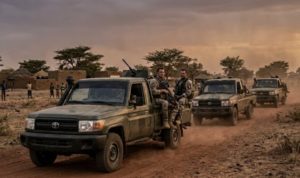
Africa Corps, a security services company directly under the control of the Russian Ministry of Defense, has between 2,000 and 2,500 « Russian instructors » in Mali (1). They had been in there since the end of 2021, under the name Wagner. A name abandoned on November 23, 2023. On April 25, 2026, when JNIM, affiliated with Al-Qaeda, and the FLA launched simultaneous offensives on Bamako, Kati, Mopti, Sévaré, Gao, Bourem, and Kidal, the Malian Armed Forces (FAMA) and their Russian allies were overwhelmed. The culmination of the attacks was the assassination of the Malian Minister of Defense, General Sadio Camara, in the Kati garrison district, which houses the residences of key Malian political officials. In Kidal, a symbol of the country’s reconquest, Russian fighters were forced to negotiate with the attackers, their evacuation to Tessalit, leaving their weapons behind. The abandoned equipment is impressive:
– a complete Bayraktar TB2 drone control, piloting, and guidance station, a Turkish-made system used by the Malian army; sensitive technology recovered by armed groups;
– several armored personnel carriers, including a Russian BTR-82A, a Chinese VP11 MRAP armored personnel carrier, and a Russian Tornado-U;
– ammunitions stockpiles, small arms, S-8 air-to-surface missiles, ZPU-2 anti-aircraft guns, and logistical equipment.
To date, the final toll of these attacks remains unknown.
2,500 Russians instead of 17,430 for MINUSMA.
Compared to the alleged 2,500 Russian fighters, MINUSMA, at the time of its departure in February 2023, had up to 17,430 personnel, including 11,739 military elements with 504 staff officers, 1,601 police officers, 3,384 civilians, and 202 volunteers. As of June 13, 2013, it had lost 192 members in combat against terrorists.
Its budget for the period between July 1, 2022, and June 30, 2023, was US 1,262,069. And yet, that force was unable to overcome insecurity. That illustrates the depth of faith the Malian authorities placed in Africa Corps. In January 2023, French General Didier Castres, former head of Operations Serval and Barkhane in Mali, expressed his skepticism: the Russian company would not succeed in an undertaking in which France had failed with thousands of troops or 5,100 to be exact. The Kremlin spokesman declined to say whether Africa Corps would be able to control the situation created by the events of April 28. He did, however, emphasize that their paramilitary forces had succeeded in preventing JNIM and the FLA from staging a coup. On a daily basis, in the field, Africa Corps fighters and the Malian Armed Forces (FAMA) operate in joint units, composed of about fifty soldiers from each branch. A key difference is that the former possess their own weaponry, communications interception capabilities, and observation drones. To maintain a degree of discretion, they generally travel in heavy Typhoon armored vehicles or similar vehicles belonging to the Malian Armed Forces (FAMA). They conduct reconnaissance patrols, sometimes with air support such as helicopters or small aircraft. On the ground, they hunt down suspected members of terrorist groups.
The cost of their services.
In early March 2023, Mali was paying nine million euros per month, or ten billion CFA francs, to Africa Corps. That figure was first reported in 2021 by Reuters. The amount was later confirmed by the then-head of the United States Africa Command (AFRICOM, based in Germany). The soldiers’ salaries range from 7,000 to 9,000 euros or between 4,584,881 and 5,894,847 CFA francs per month. That is enough to make their Malian counterparts green with envy. That disparity may not facilitate collaboration between Russians and Malians on the ground. Malian rebels from the Permanent Strategic Framework (PSF) claim to have killed 84 members of the Africa Corps and 48 Malian soldiers during the fighting in Tinzawatène, on the border with Algeria, from July 24 to 27, 2024.
Infine, in light of these figures, mercenaries and recruiting countries may make adjustments to better align with their respective expectations.
1 Papa Atou Diaw Published 8 novembre 2021 Mercenaires : cinq choses à savoir sur le mercenariat en Afrique – BBC News Afrique
1 Jean-François Dominé, « Walter Bruyère-Ostells, Histoire des mercenaires de 1789 à nos jours », Revue historique des armées [En ligne], 267 | 2012, mis en ligne le 09 mai 2012, consulté le 07 juin 2026. URL : http://journals.openedition.org/rha/7480
1 Devenir Mercenaire: Salaire 2024 (chiffres réels)
1 Voir :


https://newcentre4s.org › sahel-sadats-wagners-turcs-au-niger
1 Niger : une attaque jihadiste meurtrière frappe la région de Tillabéri
1 Unmissions.org
1 Posted on 24 janvier, 2023 by admin Afrique : La France étale sa nouvelle stratégie pour être moins visible dans certaines capitales africaines – NetAfrique.net
1 Publié le 28/04/2026 à 17:59, mis à jour le 29/04/2026 à 06:18 Au Mali, les mercenaires russes de l’Africa Corps tenus en échec face aux offensives djihadistes – L’Express
1 18/02/2022 14 : 48 Wagner au Mali : enquête exclusive sur les mercenaires de Poutine – Jeune Afrique
https://www.jeuneafrique.com/1314123/politique/wagner-au-mali-enquete-exclusive-sur-les-mercenaires-de-poutine/ 8/12
1 Lundi 20 Mars 2023 Wagner coûte une fortune aux Etats africains
1 Voir :
France 24 https://www.france24.com › fr › afrique