
 Liman NADAWA, Consultant, Center for Security Strategies in the Sahel and Sahara, Center4s.org
Increasingly, countries in the Sahel and the Gulf of Guinea are taking special measures to protect forests from terrorist control. In these hard-to-reach areas, terrorists have bases, exploit natural resources to finance themselves, and forge links with local populations, whom they transform into recruitment sources for future fighters. They also engage in smuggling. Involved in multiple forms of trafficking, they administer these enclaves according to their own governance. From there, they also launch surprise attacks against the Defense and Security Forces (FDS). The rampant exploitation of forests by terrorists groups has contributed to the spread of terrorism in the Sahel and then to the Gulf of Guinea. Regular armies are attempting to combat them, using weak air power among other means.
The Sahel and especially the Gulf of Guinea are rich in forests. For example, Benin, Burkina Faso and Niger share the W-Arly-Pendjari National Park (WAP), among other sites. The name « W » comes from the Niger River, which flows through the park in the shape of that letter. In Mali, forests cover a wide area, starting in the west, near Senegal and Mauritania, to the outskirts of Bamako and extending centrally to the borders with Guinea and Côte d’Ivoire. Nigeria’s forest cover extends over approximately 110,890 km². Treasures in peacetime, these forests are prime ambush sites for the security forces of countries fighting terrorists.
WAP National Park
With its 1,291,210 hectares, WAP is the largest forest area in West Africa. It straddles three countries, with the following proportions: Benin, 568,000 ha; Burkina Faso, 235,000 ha; and Niger, 220,000 ha. The WAP also borders Nigeria and Togo. Since 1996, the park has been set as a UNESCO World Heritage Site, designated as a biosphere reserve. A refuge for several endangered animal and plant species, the WAP also serves as a tourist destination, thus providing employment for local communities. Northern Benin, where the WAP is located, also borders the so-called « Three Borders » region: Burkina Faso, Mali, and Niger.
It is from this region that most attacks originate, not only against these countries but also against those in the Gulf of Guinea. More than 120 soldiers lost their lives near the Three Borders region between 2021 and 2024. In January 2025, about thirty more suffered the same fate. Four months later, the GSIM killed around fifty Beninese soldiers in northern Benin. According to Report 310 by the NGO International Crisis Group (2023), the WAP (West Africa Pacific) has been largely controlled since 2018 by two terrorist groups: Katiba Ansarul Islam and Katiba Serma, affiliated with the Group for the Support of Islam and Muslims (GSIM) or JNIM. ISWAP fighters have also attempted to establish a foothold there, without success. As early as 2019, JNIM kidnapped two French tourists who had ventured into the WAP, along with their Beninese guide. Both groups impose their governance there, particularly Sharia law and Zakat. Zakat, a Muslim assistance, has allowed them to acquire a large herd. They also extort gold miners and engage in all sorts of trafficking, taking advantage of the lack, or even absence, of infrastructure and state presence: food, weapons, motorcycles, fuel, and many other contraband goods; livestock trading; and the sale of motorcycles, fuel, medicines (both genuine and counterfeit), and psychotropic drugs, etc.
Forests infested with terrorists.
Northeastern Nigeria, in the state of Borneo, the Sambisa Forest, approximately 60,000 km², serves as a base for terrorist groups such as Ansaru, Lakurawa, and Mahmuda. The GSIM (Group for the Support of Islam and Muslims) has also been active in the area where the victims of the 2014 schoolgirls kidnappings were being held. Lakurawa literally means « the recruits » or « the new members » in Hausa. This terrorist group emerged between 2016 and 2017 on the border between Niger and the Nigerian state of Sokoto. It carried out attacks against Benin and Niger between December 2024 and January 2025 (Terrorism in Nigeria: Who is Lakurawa and why is the Sahel involved? February 12, 2026). Meanwhile, Mahmuda is a Boko Haram splinter group affiliated with the Islamic State in the Greater Sahara (ISGS). The Mahmuda terrorist group has emerged in north-central Nigeria and is causing chaos – Africa Defense Forum, June 10, 2025.
In Mali, threats and attacks emanating from the forests are a dramatic reality. JNIM and ISGS control such vast areas in these regions that the Malian government has declared 39 of them sanctuaries as of June 3, 2026. Dubbed “Operation Dougoukoloko” (meaning land in Bambara), the operation encompasses the Manding Mountains (Faraba), the Faya Forest (Zantiguila), and the Keniebaoulé and Bossofala Forests (Neguela) near Bamako. It also includes the west and south, with the Kékoro Forest in Bougouni, the Farako Forest in Sikasso, the Boucle du Baoulé National Park, and the Falémé Forest in Kayes. In the central and northern regions, Wagadou Forest in Nara, on the border with Mauritania, has been targeted.
These various forests are now classified as “Areas of Military Interest, Access Prohibited to the Population,” because they are “likely to serve as refuges for armed terrorist groups.” “The General Staff systematically targets all individuals located within these areas,” it was stated. Forest security measures have also been in place in Burkina Faso since 2022 and are ongoing. The Kua classified forest, located in the economic capital, Bobo-Dioulasso, has been secured, and the state has built the Pala University Hospital Center there, in the suburbs. At the time of this announcement in May 2026, the Minister of Security declared that forests must no longer be havens for criminals or smugglers, but rather spaces contributing to the socio-economic development of the country. Following a reclamation and security operation that resulted in the death of a forestry agent on June 20, 2026, Côte d’Ivoire reaffirmed its commitment to continue efforts to protect, secure, and restore classified forests throughout the national territory, in strict compliance with the laws of the Republic and for the benefit of present and future generations. In southwestern Niger, in the Torodi region, the heavily wooded areas along the border with Burkina Faso, the epicenter of jihadist violence, have been declared « red zones » by the army.
Major challenges for the security forces.
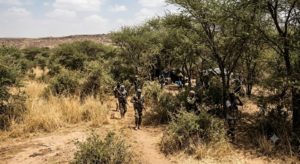
How do regular armies combat entrenched terrorists in the forests? That fight is made difficult because ground offensives would have serious human, environmental, economic, and social consequences. The terrorists use the local population as human shields. Against them, the security forces face several disadvantages:
– a certain inexperience in forest combat, compounded by dangerous wildlife and lush but stifling vegetation;
– despite efforts to recruit new soldiers, the security forces generally do not have enough personnel to secure the area and to put an end to their activities. Meanwhile, the Islamic State in the Greater Sahara (ISGS) and the Group for the Support of Islam and Muslims (GSIM) are recruiting fighters in these border areas, drawing them together based on ethno linguistic and cultural ties.
Given the difficulties faced by the security forces, in accessing the forests to fight entrenched terrorists, and due to the associated trafficking risks, the battles against the terrorists are proving arduous and perilous in that region. However, they can fight them with the help of the air force, using helicopters, drones, and other aeronautical systems. These systems – costly and hence still rare in the Sahel – are capable of monitoring the terrorists, tracking them, listening in on them, and conducting targeted strikes, without necessarily causing collateral damage. The terrorists in the forests are therefore in refuges, not sanctuaries.
2 Le 26 janvier 2023, l’ONG « International Crisis Group » a publié son Rapport 310, axé sur le parc W : Contenir l’insurrection jihadiste dans le Parc W en Afrique de l’Ouest, International Crisis Group Copyright Date : Jan. 26, 2023 Published by: International Crisis Group Pages: 39 https://www.jstor.org/stable/resrep48564
3Parc National du W du Burkina Faso : un parc aux énormes potentialités – Info Nature
4 By Africa Defense Forum (ADF), 17 mars 2026 Read Les groupes terroristes du Sahel utilisent des refuges dans les forêts pour monter des attaques
5 Sahel: Les jihadistes profitent de l’absence de coopération sécuritaire entre les États de la région – RFI – 25/05/2026
6 Bénin: le corps du guide des touristes français identifié, la « thèse de l’enlèvement se précise, publié le 05/05/2019 à 15h39 – Par AFP
7 Ibid.
8L’Essor 4 Juin 2026 – 07:31 Mali : Face aux groupes terroristes, le gouvernement sanctuarise 39 forêts et aires protégées – Actualités au Mali en temps réel et info en direct
9 Arrêté interministériel Nº2026-1311 du 03 juin 2026, République du Mali.
10 Publié le 25 Mai 2026 Le Burkina ferme ses forêts aux terroristes – Burkina Yawana
11[1] Article de Cochimau HOUNGBADJI, Afrique sur 7, 23/06/2026 Côte d’Ivoire : le sergent Koua Oua Blaise décède au front
12 Article de AFP, 02/07/2026 Les forêts au Sahel : plus que des refuges, de véritables bases d’opérations jihadistes