
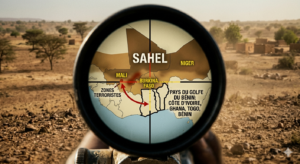
Announced long ago, including by centre4s, terrorists continued path southwards to Gulf of Benin is confirmed each day. Rather than facing that threat, a number of governments prefer to continue accusing foreign countries, adoring the idea of plot so important to powerless governments though useless on the ground.
Liman NADAWA, Sahel-Saharan Security Strategy Center, Centre4s.org
After strengthening their presence in the Sahel, terrorist groups are, since 2018, continuing their expansion in a number of countries around the Benin Gulf: Benin, Ghana, Ivory Coast and Togo. The JNIM is increasingly recruiting among local populations. The group is gradually extending its influence there, combining a penchant for trafficking, religious proselytizing, logistical activities, and raids when useful. The Islamic State in the Greater Sahara (ISGS) is also active in the area. Faced with this threat, the concerned countries are organizing their defense by purchasing weapons, recruiting soldiers and forging new partnerships for various forms of support.
In 2024, the number of deaths caused by Sahel conflicts exceeded 25,000 for the first time. On Burkina Faso’s southwestern border, groups affiliated with the GSIM movement are harassing northern Côte d’Ivoire. Their casualties there rose from 267 in 2023 to 361 in 2024. Benin and Togo recorded 153 and 96 deaths respectively that same year. Elements of the GSIM, notably Ansarul Islam and Katiba Hanifa, operate in northern, eastern, and southeastern Burkina Faso, and then advance further south into the border areas with Benin and Togo. Katiba Hanifa has established itself in the W-Arlit-Pendjari reserve, straddling Benin, Burkina Faso and Niger. In April 2026, an attack attributed to that same GSIM claimed the lives of 54 Beninese soldiers. According to Reuters, these terrorists, who are fighting in Burkina Faso, also use the southern border area with Ghana as a logistical and medical base. The attraction of the Gulf is fueled by a variety of factors: denser populations than those of the Sahel, a significant Muslim population, prosperous economies, natural resources, and secure sanctuaries. The Gulf is a space where giant cargo ships cross paths with oil platforms, where fishermen operate alongside pirates and where millions of tons of cocoa, oil and minerals leave Africa to supply the world. This dynamism and wealth attract the jihadists. As does ethnic factors that should also be noted: some border populations are present in several countries throughout the Sahel states and around the gulf of Benin. That ethnic factor is to be noted as tribal solidarities facilitate terrorists clandestinely.
Benin: more soldiers.
To counter the terrorist threat along its borders, Benin has mobilized a force of 3,000 soldiers in 2022. Since then, an additional 5,000 troops have joined their ranks in the northern region. In April 2023, it signed military assistance agreements with Rwanda. In 2024, the Rwandan Defense Forces (RDF) were deployed effectively and reliably to Darfur, Sudan, for peacekeeping operations. Subsequently, the RDF has proven their abilities in other theaters of wars: Liberia, South Sudan, Mali, Ivory Coast, and Haiti. Currently, they are operational in the Central African Republic and in Mozambique’s Gabo province, where they are countering rebel groups and jihadists. In mid-December 2024, Benin benefited from a strengthening of the French army’s operational capabilities: armored personnel carriers, a transport bus for the two military academies in Bembèrèké and Natitingou, engineering equipment, and training in France of soldiers for equipment maintenance and air force pilots. The European Union also provided military aid to Benin.
Ghana: New Partnerships.
As early as 2022, a Ghanaian researcher reported that two to three hundred young women and men had been recruited in the country north and had joined the GSIM and the EIGS. After « training » in camps in the Sahel, these young people returned home to proselytize. The researcher added that porous borders lead to smuggling, arms trafficking, and human trafficking. The authorities have made this a major concern, in a context where ethnic conflicts and disputes between chiefs can easily be exploited. On March 11, 2026, Ghana and the European Union signed a defense and security partnership, presented as « the first of its kind between the EU and an African country. » Three areas are covered: strengthening the early warning, conflict prevention, and crisis management capacities of the Ghanaian army. For the EU, the agreement is part of a broader framework that recognizes, among other things, that Africa’s strategic resources are essential for its economic growth and ecological transition. Ghana is located at the crossroads of the Sahel and the Gulf of Guinea. Alongside military regimes that have come to power through coups, the country is demonstrating its liberal democratic ambitions. Closer ties with Europe will provide Ghana with European funding, training programs, and privileged partner status within European security frameworks. But the EU is entering territory already partially close to the United States, which has signed a military cooperation agreement with it. The US military thus has access to extensive logistical facilities at Ghanaian bases. It was able to use it to launch its strikes against jihadists in Nigeria in December 2025.
Togo: Controlling the flow of weapons at the port.
As the Sahel countries are landlocked, most of the military equipment destined to them transits through the ports of the Gulf of Guinea countries. The same is true for arms to the jihadist groups. Togo is positioning itself as a mediator between the ECOWAS member states and those of the ESA. In the case of the 49 Ivorian soldiers arrested and detained in Mali from July 12, 2022, to January 6, 2023, its role was decisive. It was Lomé that ultimately secured their liberation after a lengthy negotiation process. Idem, Togo demonstrates its loyalty to the Special Economic Authority (SEA) by intercepting military equipment, destined to jihadists, transiting through its port.
Ivory Coast: Rapprochement with the United States.
The security challenges facing Burkina Faso and Mali are fueling concerns in Abidjan. From its two northern neighbors, terrorists attack Ivory Coast along their shared 1,100 km border, which is costly to control continuously. This volatile situation sometimes leads to misunderstandings between the two sides, who accuse each other of illegal incursions by soldiers across their shared border. On March 13, 2016, Grand-Bassam seaside resort was attacked by a commando unit affiliated with AQIM (Al-Qaeda in the Islamic Maghreb). Following that 2020 serious incident, the joint post at Kafolo was attacked by jihadists operating across Burkina Faso border, resulting in the deaths of fourteen soldiers. On October 21, 2021, an attack occurred against the Téhini checkpoint, not far from the Burkina Faso border. Two Ivorian gendarmes were wounded and one of the assailants killed. The attack was attributed to a terrorist named Hamza, who had been sent to Côte d’Ivoire to create a safe haven for jihadists. Terrorists finance themselves through illicit activities: kidnappings for ransom, armed robberies of motorists, highway robbery, etc. On April 26, 2026, six persons were sentenced to life imprisonment for these acts in an Abidjan court. On August 24-25, 2025, the village of Difita, in the Téhini department, northeast of the country, was attacked, resulting in the deaths of four farmers.
The Ivorian government has established an International Counterterrorism Academy to improve the understanding and coordination of counterterrorism operations. In addition, it has signed agreements with the United States to strengthen the capabilities of the Ivorian Armed Forces. Drones intended for surveillance and security of the northern border areas with Burkina Faso and Mali are expected to be deployed soon, courtesy of the U.S. This choice of the northern border is also intended to protect trade routes and the country natural resources.
After a form of conquest of the Sahel, the jihadists are now resolutely turning their attention to the countries of the Gulfs of Benin and Guinea. Despite their differences, particularly within the framework of ECOWAS, the countries of the Southern African Economic and Monetary Community (SAEC) and all their neighbors seem to recognize their common interest in uniting in a single fight: combating the terrorism that is gaining ground. A scourge affecting them all.
[1] mai 28, 2025 Le financement du terrorisme au Sahel et en Afrique de l’Ouest : Mécanismes, moteurs et réponses – CISA NEWSLETTER
[1] By ADF6 mai 2025Updated:6 mai 20255 Mins Read La violence des islamistes militants au Sahel continue à se propager vers la côte – Africa Defense Forum
[1] Golfe de Guinée : le ventre stratégique de l’Afrique sous haute tension – Afro Sync Press Agency
[1] Euronews, Bénin : 15 soldats tués lors d’une attaque.
[1] 18 Déc. 2024 à 14:40| Coopération militaire entre le Bénin et la France : Faire monter en puissance les capacités des Forces Armées Béninoises | Gouvernement de la République du Bénin
[1] Par MondAfrique – 25 mars 2026 Ghana : pont régional ou pilier occidental ? – Mondafrique
[1] Publié le 25 juillet, 2025 20:35 Lomé traque l’arsenal militaire de l’Azawad : Faure Gnassingbé affiche sa loyauté envers l’AES – NetAfrique.net
[1]By Abdou Razak OUEDRAOGO – 26 août 2025, Attaque terroriste en Côte d’Ivoire : Quatre (04) personnes ont été tuées | Aconews
[1] Côte d’Ivoire : la sécurité nationale menacée par le terrorisme | Analyses | Perspective Monde
[1] Côte d’Ivoire : Perpétuité pour six accusés au procès de l’attaque terroriste de Kafolo, 28 avril 2026.
[1] Publié le 8 janvier, 2026 19:18 Côte d’Ivoire : Une société américaine de défense s’implante dans le Nord du pays – NetAfrique.net